During iron ore processing, HPGR (High-Pressure Grinding Roll) feeding chutes are subject to severe abrasion from large quantities of granular material. Although traditional high-chromium liners have a history in wear-resistant applications, they continue to show clear weaknesses under typical Australian iron ore conditions, including short service life, high maintenance frequency, and difficult-to-control operating costs.
Customer Site Conditions:
Material: Iron ore
Particle size: 10–50 mm (majority between 20–30 mm)
Drop height: 2–3 meters
Annual capacity: Approx. 6,500 tons
In actual operation, the high-chromium liner wore extremely severely, especially in the impact area of the falling material. The wear rate far exceeded expectations, leading to frequent liner replacements, which not only increased spare parts costs but also seriously affected equipment uptime and production .
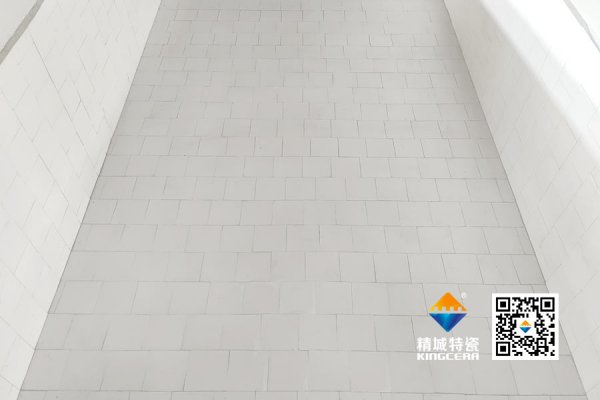
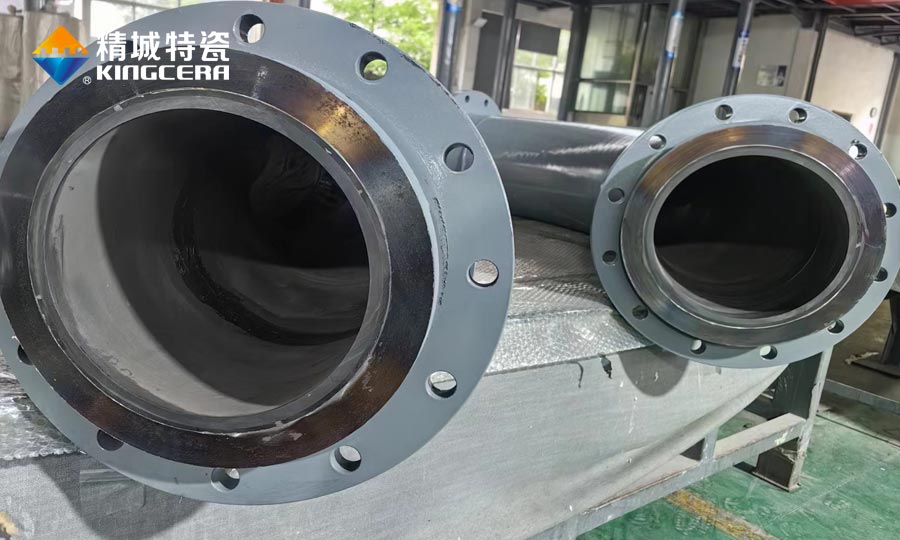
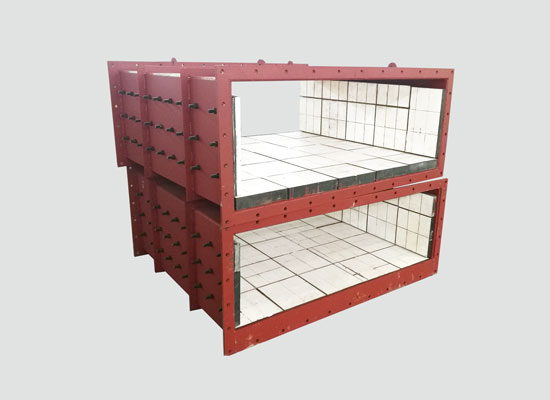
Solution: Sintered Silicon Carbide Ceramic Wear Liner with Wear-Resistant Bar
To solve the above issues, our company recommended replacing the existing liner with sintered silicon carbide ceramic liner with wear-resistant bar. This material offers the following key advantages:
Extremely high hardness: Mohs hardness above 9, far exceeding that of high-chromium cast iron
Excellent wear resistance: Service life 3–5 times longer than high-chromium liners
High temperature and corrosion resistance: Suitable for complex conditions such as wet ore and impurities
Actual application results prove that after switching to sintered silicon carbide
ceramic wear liners, the wear resistance has significantly improved, service life has been greatly extended, and maintenance frequency has noticeably decreased.
Continuous Optimization: Local Reinforcement at the Discharge Area
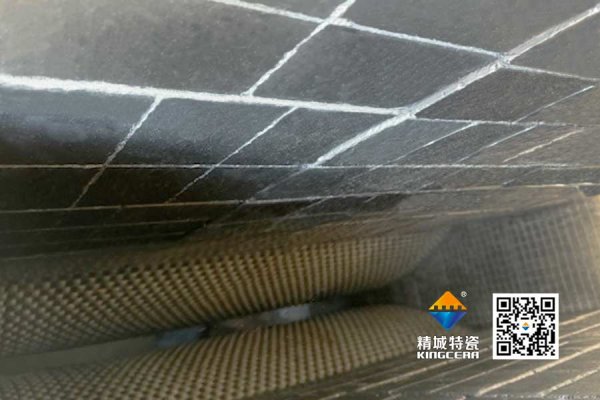
Although the main liner performed excellently, wear remained relatively concentrated at the chute discharge area due to factors such as increased material flow velocity and changes in impact angle. To completely solve this local weakness, we added two wear-resistant steel bars to the edge of the silicon carbide wear liner, forming a composite structure of "ceramic for primary wear resistance + steel bars for impact resistance."
This optimized solution perfectly solved the impact wear problem at the liner edges, eliminates the weakest point in the entire chute wear system, further extends overall service life, and achieves true balanced wear across the entire area.
Customer Feedback and Economic Benefits
After the two-step modification ( sintered silicon carbide for the main area + composite wear-resistant steel bars at the discharge area), the customer reported:
-
Liner replacement intervals significantly extended, greatly reducing equipment downtime
-
Spare parts procurement and labor maintenance costs significantly reduced
-
Production continuity and Overall Equipment Effectiveness reliably improved
Conclusion: Technology-Driven Wear Upgrades to Help Mining Reduce Costs and Increase Efficiency
Wear problems in industries such as iron ore, metallurgy, steel, cement, and aggregates are never solved by "just replace and forget." Truly effective solutions require material selection based on actual operating conditions and targeted design for local weak points.
Our sintered silicon carbide ceramic wear liner + locally reinforced composite wear structure has been fully validated in severe conditions such as Australian iron ore HPGR chutes. If you are also facing high wear and high maintenance costs, please contact us for a customized solution.
Michael Liu








 中文
中文 English
 Pусский
 Español
 日本語
日本語 한국어
한국어