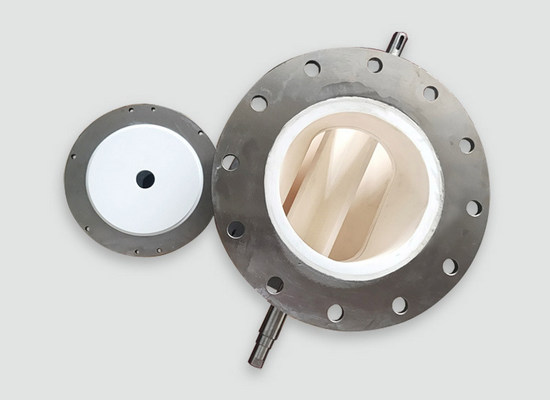
In the mixing phase of lithium battery materials, metal contamination constitutes a substantial potential risk. Even if minuscule metallic wear debris mixes into the cathode and anode materials, it may cause battery micro-short circuits, increased self-discharge, or even trigger safety hazards. Therefore, internal components of the mixing equipment that come into contact with the materials must achieve “metal contamination isolation” to the greatest possible extent.
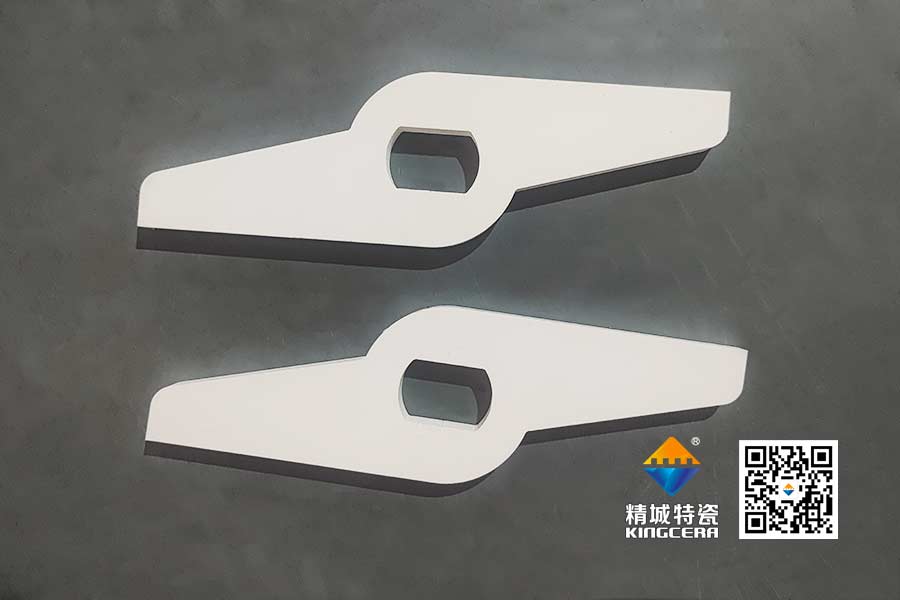
The flying knives in traditional mixers are predominantly made of metal, making wear and detachment inevitable during high-intensity agitation. The emergence of ceramic flying knives provides a clear pathway for optimization and upgrading: replacing metals with non-metals to isolate contamination at the source.
However, manufacturing ceramic flying knives is highly challenging. Especially when the client is a global leading enterprise, the requirements are elevated to an extremely stringent level.
Regarding the material, the client specified ARZ ceramics, which is a zirconia composite material. Integrating both high toughness and high hardness, this material can maintain long-term structural integrity in a high-impact, high-wear mixing environment.
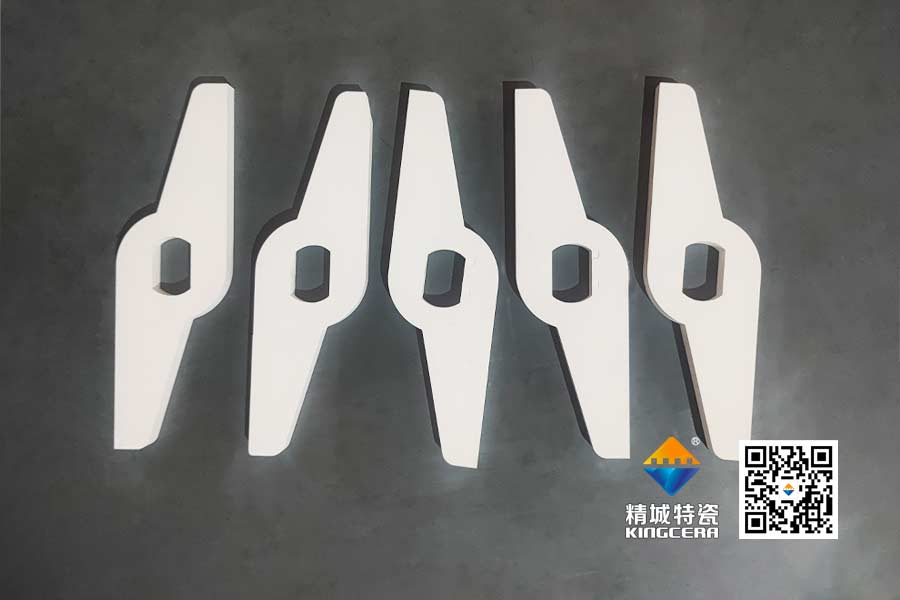
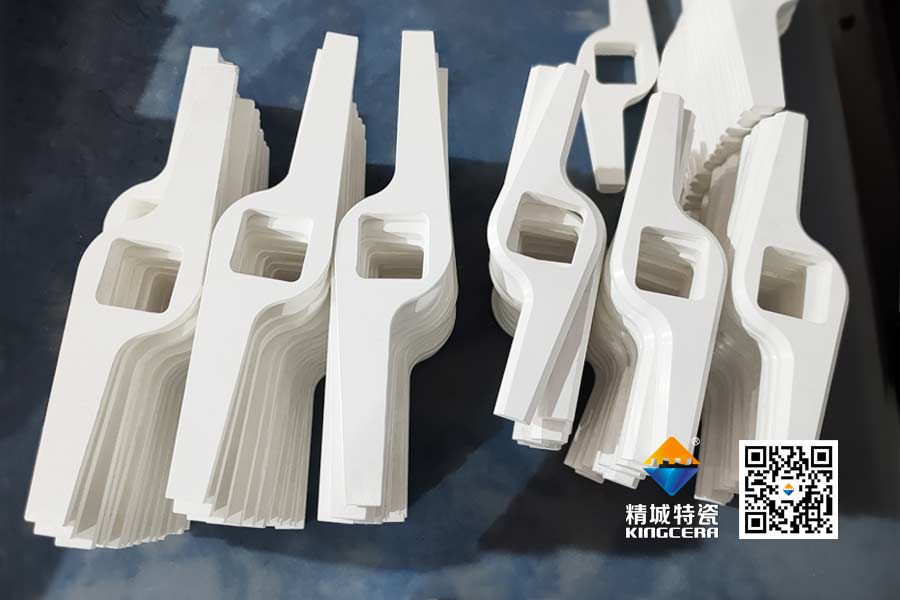
In terms of dimensions, the length of the flying knife reaches 178 mm. For ceramic materials, this dimension poses a considerable challenge to the manufacturing process. The shrinkage during the ceramic sintering process is not perfectly uniform; as the length increases, the difficulty of dimensional control rises exponentially.
Even more formidable is its shape. It is not a simple strip or plate, but an irregularly shaped component featuring chamfers and holes. The chamfers necessitate precision ceramic machining after sintering, while the holes involve mold design during the forming stage and positioning accuracy during subsequent machining. Furthermore, the client’s requirements for the final dimensional accuracy are extremely high, demanding that positive and negative tolerances be kept within 0.05 mm.
After extensive investigation, the client ultimately selected Kingcera, which enjoys an excellent reputation both domestically and internationally within the industry; subsequently, Kingcera successfully fulfilled the order with its robust foundation and technology.
The first aspect is the production line. Kingcera possesses a complete structural ceramic production line, where all processes—from powder preparation, isostatic pressing, and high-temperature sintering to CNC precision machining and testing—are completed entirely within its own factory premises. This implies higher controllability for every procedure, enabling rapid traceability and adjustment if any issues arise.
The second aspect is the equipment. For 178 mm long, irregularly shaped components, ordinary machining equipment struggles to ensure consistency. Kingcera employs high-precision CNC machining centers, complemented by specially designed fixtures, engraving machines, internal and external grinding machines, and other advanced equipment to guarantee the accuracy of chamfers and holes.
However, what truly transforms this flying knife from a blueprint into a tangible product is experience. Ceramic processing differs from metalworking; it is not as straightforward as a single clean cut. The slightest deviation in ceramic grinding parameters, cooling methods, or feed rates can generate micro-cracks; these micro-cracks will gradually propagate during subsequent use, leading to the sudden fracture of the flying knife. Kingcera’s technical team has accumulated over thirty years of experience in the deep processing of ceramics, thoroughly understanding what parameter combinations can simultaneously ensure efficiency and minimize material damage.
The dimensional accuracy of the ultimately delivered product fully met the standards, with smooth chamfers and precise hole positioning, garnering high affirmation from the client.
Starting in 2023, this batch of ceramic flying knives has been put into use across multiple domestic lithium battery material production lines, and simultaneously exported to South Korea. According to user feedback, they operate stably with an amount of wear significantly lower than that of the previous metal flying knives; more importantly, they introduce zero metal contamination.
For lithium battery material suppliers, this signifies a guarantee of product purity and provides an added layer of confidence during client audits.
Kingcera’s ability to fulfill this order relies not on an isolated “black technology,” but on a complete manufacturing chain, a profound understanding of ceramic material processing, and an attitude of willingness to tackle formidable challenges.
The ceramic flying knife is merely one case study. In the field of
structural ceramics, numerous similar demands exist: irregular shapes, large sizes, high precision, and high reliability. Behind every requirement lies a manufacturing challenge that must be overcome.
Kingcera specializes in structural ceramics, particularly excelling in the customization and processing of non-standard, irregularly shaped components.
(Original link:
ARZ陶瓷飞刀:大尺寸高精度结构件,锂电混料阻隔金属污染 )
Samuel Wu / Translated



 中文
中文 English
 Pусский
 Español
 日本語
日本語 한국어
한국어